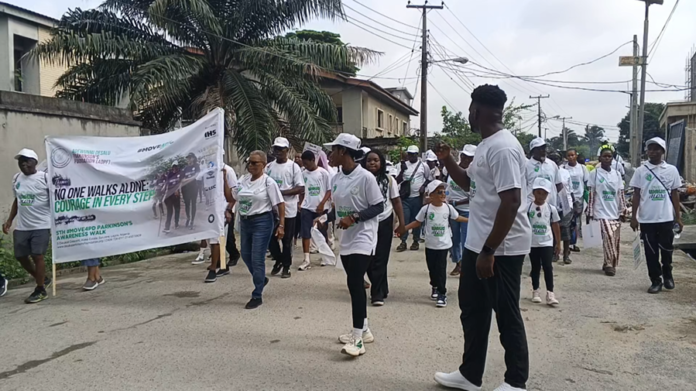
Hundreds of people living with Parkinson’s disease, alongside caregivers, health professionals and advocates, took to the streets around the National Stadium in Lagos on Saturday for an awareness walk, demanding greater recognition, affordable treatment, stronger government support and an end to the stigma surrounding the condition.
The two-kilometre walk was organised by the Adewunmi Desalu Parkinson’s Foundation (ADPF) as part of the fifth Move for Parkinson’s Disease Awareness Walk.
Under the theme, “No One Walks Alone: Courage in Every Step”, participants carried placards bearing messages including “Stop the Stigma”, “Unity in Motion: Raising Parkinson’s Awareness” and “Join the Journey, Conquer Parkinson’s with Love” among others.
For many Nigerians living with Parkinson’s disease, the battle extends beyond the progressive neurological condition to stigma, delayed diagnosis and the daily difficulty of accessing treatment and specialised care.
Related Posts:
- FULL TEXT: Dapo Olorunyomi’s lecture at Ajayi Crowther University on Nigerian journalism
- World Parkinson’s Day: Advocates push awareness amid widespread misdiagnosis in Nigeria
- In Nigeria, high treatment costs, neglect push Lupus patients to the brink
- Meet Olusolape, a Nigerian nurse using songs, humour to transform maternal healthcare
Walking with courage
In her opening address, the founder of ADPF, Omorinsojo Desalu, said the walk was a reminder that no person living with Parkinson’s disease should face the journey alone.
“Two kilometres may sound modest on paper, but for some among us, every single step was an act of bravery,” she said.
“For others, it was a promise renewed to a loved one. And for all of us, it was a declaration that in the face of Parkinson’s disease, no one, absolutely no one, will walk alone.”
Ms Desalu said this year’s theme reflects the resilience of people living with Parkinson’s disease and the families who support them every day.
She said courage should not be measured by the absence of tremors or physical limitations, but by the determination to continue living despite them.
“Courage is not the absence of stiffness or fear. It is what we witnessed on the road today: a caregiver matching the pace of the person they love, a grandchild slowing down for a grandparent, and strangers becoming family before the finish line.”
For years, she noted, Parkinson’s disease had remained hidden behind silence and misconceptions, leaving many families to cope in isolation.
“But today, we stand together to break that silence,” she said. “You are not defined by a diagnosis. Parkinson’s is something you live with; it is not who you are.”
Ms Desalu also acknowledged caregivers, describing them as unseen heroes whose sacrifices often go unnoticed.
“You adjust your schedules, learn medications and become physiotherapists at midnight. The love you give is medicine no pharmacy can dispense.”
While appreciating government representatives for supporting the campaign, she urged authorities to go beyond symbolic participation.
“We need Parkinson’s disease to be recognised as a national health priority. We need affordable access to medication, early diagnosis and better training for primary health workers so people can be treated with dignity wherever they live.”
Participants recount stigma and daily struggle
Behind the campaign were personal stories of resilience, lost independence and discrimination.
For Deborah Ifeanyi, the journey began in 2018 when one of her hands started shaking. Like many Nigerians, she ignored the symptom until doctors diagnosed her with Parkinson’s disease four years later.
“I didn’t even know what Parkinson’s was,” she recalled.
“You can wake up looking completely fine, and within minutes your body changes. You cannot predict how your day will go.”
She said the condition had gradually made everyday activities difficult, forcing her to depend on others for support.
One of her biggest challenges, however, has been public misunderstanding. She recalled being rejected by commercial transport operators whenever her symptoms became visible after her medication wore off.
“There was a day market women tried to help me get a tricycle. The first rider refused to carry me. They brought another one, and he also refused unless somebody followed me. We argued for almost 30 minutes before someone finally agreed.”
For her, such experiences reflect how little the public understands Parkinson’s disease. “It breaks your heart when you can no longer do things you used to do for yourself.”
She also called for improved access to medication, warning that missing treatment for a short period could significantly worsen symptoms.
“If you stay without medication for one week, it feels as though the disease has started all over again.”
Despite the challenges, Ms Ifeanyi credited the foundation with helping many patients regain hope through physiotherapy, counselling and support programmes. “They said they would hold our hands, and they have kept that promise.”
Another participant, Solomon Otomewa, said he initially dismissed his trembling hands as a normal sign of ageing until a doctor at the Lagos University Teaching Hospital (LUTH) diagnosed him with Parkinson’s disease.
“I went home and cried,” he recalled. “I kept asking, ‘Why me?’”
Fear drove him away from medical treatment as he sought alter native remedies, including paying N350,000 to a herbal practitioner who claimed he could cure the disease. “Nothing changed,” he said.
He eventually returned to conventional treatment and joined the foundation, where he met other people living with Parkinson’s disease. “I realised I was not alone, and that Parkinson’s is not a death sentence.”
Mr Otomewa said regular physiotherapy and exercise had helped to improve his movement and quality of life. He encouraged newly diagnosed patients not to isolate themselves, but to seek professional care and support groups.
Caregivers shoulder the hidden burden
While Parkinson’s disease primarily affects patients, caregivers said the condition also quietly transforms entire families.
For Justina Onwudinjo, who cares for her younger sister living with Parkinson’s disease, caregiving has become a full-time responsibility requiring patience, sacrifice and compassion.
She said she had to reorganise her daily routine to accompany her sister to therapy sessions and medical appointments.
“I realised it was a work of mercy,” she said. “My sister could hardly speak before joining the foundation, but today she interacts with people again. The physiotherapy and support have made a remarkable difference.”
Another caregiver, Ekaette Bassey, said Parkinson’s disease had fundamentally changed her marriage, as her husband gradually became dependent on her for many daily activities.
“You no longer have your own time,” she said. “Somebody depends on you for almost everything.”
Despite the emotional and physical demands, she said the experience had strengthened their relationship.
“It has brought us closer because we now spend more time together and support each other through every stage.”
The caregivers agreed that while medication is important, patience, understanding and emotional support remain essential to helping people living with Parkinson’s disease maintain their dignity and quality of life.
Experts explain Parkinson’s disease
Health experts at the ADPF said improving public understanding of Parkinson’s disease remains one of the most effective ways to ensure early diagnosis and better outcomes for patients.
Olayinka Tejumola, a Physiotherapist explains that although Parkinson’s disease has no cure, a combination of medication, physiotherapy and lifestyle interventions can help to manage symptoms and improve patients’ quality of life.
“There are different therapies we recommend for people living with Parkinson’s disease,” he said.
“These include dance therapy, movement exercises and handwriting exercises for people whose writing has become smaller because of the disease. Regular exercise is very important because it helps people maintain movement and independence.”
Mr Tejumola urged Nigerians not to avoid people living with Parkinson’s disease, stressing that the condition is neither contagious nor caused by spiritual forces.
“When you see someone with shaky hands or other symptoms of Parkinson’s, show them love,” he said.
“Parkinson’s is not contagious. It is not airborne or waterborne. You cannot get it by coming in contact with someone living with the disease. Give them a handshake, encourage them and let them know they are not alone.”
Another physiotherapist with the foundation, Titilayo Ojo, said public awareness remained low despite the growing number of people living with the condition.
She explained that Parkinson’s is a neurological disorder caused by changes in the brain and should not be mistaken for old age or a spiritual affliction.
“We want people to know that Parkinson’s exists and that it is not a spiritual attack,” she said. “It is a condition that affects the brain and it requires medical attention.”
According to Ms Ojo, while Parkinson’s is more common among people aged over 60, younger adults are increasingly being diagnosed.
She said early symptoms often include persistent trembling of the hands, slowed movement, difficulty maintaining balance and a stooped posture.
“Many families don’t recognise these signs until the disease has progressed,” she said.
“Sometimes I see people on the road showing obvious symptoms and I wish I could stop to encourage them to visit a hospital. Many people are living with Parkinson’s without knowing what is happening to them.”
She added that delayed diagnosis often deprives patients of the opportunity to begin treatment early enough to preserve mobility and independence.
Early diagnosis remains key
Ms Desalu said that while Parkinson’s disease has no cure, early diagnosis and access to treatment can help people live long and productive lives.
Using the foundation’s motto, “I will hold your hand so you won’t fall”, she said the organisation was established to ensure that no Nigerian living with Parkinson’s disease faces it in isolation.
“Our message is simple: no one walks alone,” she said.
“We want people living with Parkinson’s, their spouses, caregivers, children and families to know that we are walking with them. We also want every Nigerian to recognise the symptoms, support people living with the disease and reject the stigma that surrounds it.”
She lamented that many Nigerians still attribute Parkinson’s symptoms to witchcraft or spiritual attacks, delaying medical intervention.
“When people see someone shaking, they often think it is a spiritual problem. But Parkinson’s is a neurodegenerative disease, and people need to go to the hospital, not hide in silence.”
Ms Desalu noted that although Parkinson’s was once regarded as a disease affecting only older people, increasing cases among younger adults had changed that perception.
“Our youngest patient is under 30 years old. We have women in their forties and men in their thirties living with Parkinson’s. This is why awareness is so important because it may not be your concern today, but it could become your concern tomorrow.”
She called on governments at all levels to prioritise Parkinson’s disease by improving access to neurologists, physiotherapists and affordable medication, while investing in research and training for primary health workers.
“We need our health workers. We need more physiotherapists, psychologists and neurologists. We also need research because we do not know where the cure will come from. Nigeria must be part of the global search for solutions.”
The foundation, she said, had recorded a steady rise in the number of people seeking support since it was established in April 2022.
“We started with just two patients,” she said.
“Today, we have more than 200 people living with Parkinson’s registered with the foundation in Lagos alone. There are many more across Nigeria who still need support.”
Call for stronger partnerships
Also speaking at the event, the Director of Corporate Communications at IHS Nigeria, Sylva Ifedigbo, described Parkinson’s disease as one of the country’s least understood health conditions and called for stronger collaboration to improve awareness and access to care.
“Today is about more than taking a walk. It is about standing with people living with Parkinson’s disease, honouring their courage and reminding them that no one should face this journey alone.”
He said meaningful partnerships between the private sector, civil society and government were essential to improving health outcomes for people living with Parkinson’s disease.
According to him, increased awareness would not only reduce stigma but also encourage policy reforms, including wider access to treatment through health insurance.
“A lot of people living with Parkinson’s cannot afford the care they need. It is important that conversations begin around including Parkinson’s treatment under Nigeria’s health insurance coverage so that more patients can access the medication and rehabilitation they require.”
Author
-
Sodiq Mojibola is a Nigerian-based multimedia journalist. He has experience covering metro and environment beats.
Source: Development Reporting

